
Report
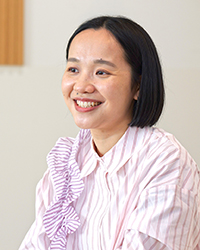
Shoei Nakaie
- Affiliation
- Graduate School of Languages and Linguistics
- Course and Grade
- 2025 SPRING Project Completed
- Research Themes
- Heritage Language and Identity of Second-Generation Immigrants in Japanese Society
Reason for entering the doctoral program
Even when the unexpected happens, keep moving toward my clear goal
I am currently affiliated with a linguistics program; however, during my master’s studies, I conducted research in Japanese language education at a graduate school of another university. Over time, my academic interests shifted, and I began to pursue research in the field of applied linguistics. As a result, I changed graduate schools when entering the doctoral program.
From the very early stages of my master’s program, I had already been considering the possibility of advancing to a doctoral program, and therefore began gathering information and developing a long-term academic outlook at an early point. In addition, having had prior experience working in the private sector before entering graduate school, I was motivated to pursue a career as a specialist rather than returning to corporate employment. For these reasons, progressing to a doctoral program felt like a natural and logical step for me.
Originally, I had planned to continue into the doctoral program under the supervision of my master’s advisor. However, due to the advisor’s relocation, I decided to take the opportunity to seek a new supervisor. As this coincided with the final stage of writing my master’s thesis, I did not have sufficient time at that point to find a new advisor. After completing one year, I remained at the university as a research student while continuing my search for a suitable supervisor. Sophia University stood out as the institution where a faculty member whose research interests closely aligned with the direction I wish to pursue was based. While its location in central Tokyo was certainly advantageous, my decision was primarily driven by the desire to study under that particular professor. Consequently, I decided to enroll in the doctoral program at Sophia University.
Research objective
Heritage Language and Identity of Second-Generation Immigrants in Japanese Society
Heritage language means that parents mother tongue for second-generation immigrants.
In recent years, the number of foreign residents who come to Japan and settle here has been rapidly increasing for a variety of reasons. As a result, Japanese language education for these populations has been increasingly expanded. While it is certainly true that learning Japanese is essential for living in Japanese society, the strong emphasis placed on Japanese language acquisition often comes at the expense of opportunities for heritage language education.
More specifically, children of foreign origin living in Japan—including second-generation immigrants—are often born and raised in Japanese society. Consequently, their proficiency in Japanese tends to become dominant, while maintaining and using their heritage language gradually becomes more difficult. Under such circumstances, the conflicts they experience regarding their heritage language and their identity are highly complex and cannot be easily described in simple terms.
In my research, I explore the life histories of these individuals in order to shed light on their linguistic experiences and identities in relation to the languages that surround them, including their heritage language and Japanese. I believe that the findings of my research can contribute valuable insights toward improving language education environments for children of foreign backgrounds and immigrant communities in Japan.
The attractiveness of SPRING
Support from Various Programs and the Expansion of My Research Achievements
When I think back to when I was selected as a SPRING student, it felt as though those around me were telling me, “You may focus on your research.” That sense of encouragement was deeply meaningful to me.
Before being accepted into the SPRING program, all research-related expenses—such as academic books and travel costs for conferences—had to be covered entirely out of pocket. Receiving financial support in this way has therefore been truly gratifying, and I am deeply grateful for it. Prior to my acceptance, the need to personally bear research expenses imposed significant constraints: I was unable to purchase expensive academic books and instead had to search through multiple libraries, and I could only attend academic conferences in the metropolitan area. These limitations created a constant dilemma, as minimizing expenses often meant that I could not effectively advance my research. Given this situation, I believe that being selected for SPRING and receiving research funding has enabled me to significantly increase my research output.
In addition to SPRING, Sophia University’s own graduate student research support programs have also been extremely generous, providing assistance for conference travel expenses and English proofreading costs. Although slightly outside the scope of my research activities, I was also given the opportunity to participate in a workshop for graduate students organized by the International Federation of Catholic Universities, held in Rome, Italy. This experience offered me valuable perspectives that have positively influenced my research.
Before being selected for SPRING, I was honestly not considering conducting research abroad or disseminating my work in English. However, through programs that covered English proofreading costs, provided opportunities to publish papers in English, and supported international research exchanges, my outlook on my future has changed dramatically.
I also carry out my research alone at home. There are periods when I visit the Yotsuya Campus only once a month or even less, mainly for administrative procedures or library use. While the SPRING project offers various professional development programs for doctoral students, one of the most meaningful aspects for me was the opportunity to connect with other doctoral students at a similar life stage. Since my second year, I have had more chances to see and speak with them than in my first year.
Even without engaging in in-depth discussions about research, simply being able to share a sense of solidarity—such as recognizing that there are others of a similar age, particularly women, who are also thinking seriously about their future careers—has been incredibly valuable to me. This sense of connection and mutual understanding has been one of the most positive experiences I have gained through the program.
Future career prospects
Deepening My Experience as a Researcher
Looking ahead, I hope to build my career as a researcher both in Japan and abroad. If possible, I would like to spend time overseas, whether as a faculty member or a research fellow, and engage in research while residing there. After gaining experience conducting research abroad, I plan to return to Japan and continue my academic work.
For those interested in SPRING project
A Valuable Training Opportunity
I believe that preparing an application is an excellent training opportunity to reflect objectively on one’s own research and to learn how to effectively communicate its strengths. For anyone who is interested, I strongly encourage you to take on the challenge.
Being able to speak about your own research with confidence is, I believe, something quite universal among researchers. I hope everyone will approach SPRING with confidence and apply in a natural, authentic way.