
Education and Research Results
Event Record
【Event】SPRING Student Participated in the U.S. and Japan Digital Innovation Hub & Advanced Technology Workshop
A SPRING student from Sophia University participated in the “10th Annual U.S. and Japan Digital Innovation Hub & Advanced Technology Workshop”, which was held at Purdue University in Indiana, USA, from September 7 to 9, 2026.
This workshop brought together representatives from universities, research institutions, industry, and government in both Japan and United States. Its goal was to strengthen collaboration, promote joint research, and support human resource development in advanced technology fields.
This fiscal year’s theme was “AI Convergence”. Active discussions were held on advanced technologies that are expected to transform society, including semiconductors, quantum technology, advanced manufacturing, and space technology.
During the workshop, students from Japan and the United States participated in poster session and had opportunities to interact with researchers and industry professionals. The SPRING student presented his research and gained a deeper understanding of research activities and career development from an international perspective.
Sophia University will continue to support the international research activities and career development of doctoral students.
<Report from the Participant>
Activities and People I Interacted With
I participated in the student poster session and presented my research on a propulsion system using a new combustion method related to the Space field. During the presentation, I explained the background of the research, the features of the proposed combustion method, and its potential applications in space propulsion. I also exchanged ideas with other participants.
Many of the participants came from fields different from my own. This made me realize the importance of explaining the background and significance of my research in a way that can be understood by people outside my area of expertise.
Unlike the academic conferences I usually attend, this workshop allowed me to interact with a wide range of people from government, industry, and academia in both Japan and the United States. It provided a valuable opportunity to think about career development, human resource development, and industry-academia collaboration, all of which are important for continuing a research career in academia.
As I was the only student participant from Japan, I had the opportunity to interact with government officials from the United States, Japan, and the State of Indiana, as well as executives and employees from Japanese and American companies, and faculty members and students from U.S. universities, including Purdue University.
In addition to discussing my research, I exchanged views on doctoral education and employment systems in Japan, research environments, and the challenges faced by Japanese researchers conducting research in the United States. Through these discussions, I learned that the position of doctoral students and research environments differ between Japan and the United States. I also realized the importance of promoting international collaborative research and building long-term networks, while continuing efforts to improve Japan’s education and research environment.
Impressions and New Perspectives
One of the most impressive lessons from this workshop was how AI is changing research. There were active discussions on the use of generative AI and other AI technologies across many fields, and both universities and companies were conducting research related to Physical AI. I learned that AI is already being used with experimental equipment and analytical technologies to automate research processes from data collection to analysis. At the same time, effective use of research data requires common rules for data sharing, intellectual property, and security. From the perspective of technology diplomacy, governments, universities, and companies in Japan and the United States need to work together to establish frameworks for the safe and effective use of research data.
I also felt it is important to build on the knowledge and networks gained through this workshop rather than treating them as temporary achievements. Sharing lessons learned within institutions and using them to develop new exchanges and collaborative projects would further increase the value of this initiative.
On the final day, I visited the Birck Nanotechnology Center at Purdue University. The facility supports semiconductor education and research by providing advanced equipment and an environment for developing talent needed by industry.
Companies contribute personnel and equipment, while the university provides highly trained students. This close connection between human resource development and collaborative research demonstrated that industry-academia collaboration should focus on building long-term educational and research environments that support continuous exchanges of people, skills, and knowledge.
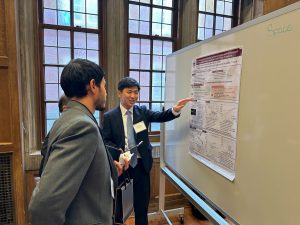
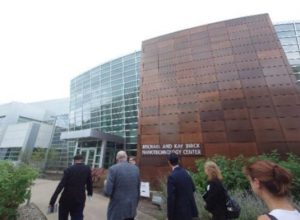
Presentation during the Poster Session Birck Nanotechnology Center (Semiconductor Research Institute)